
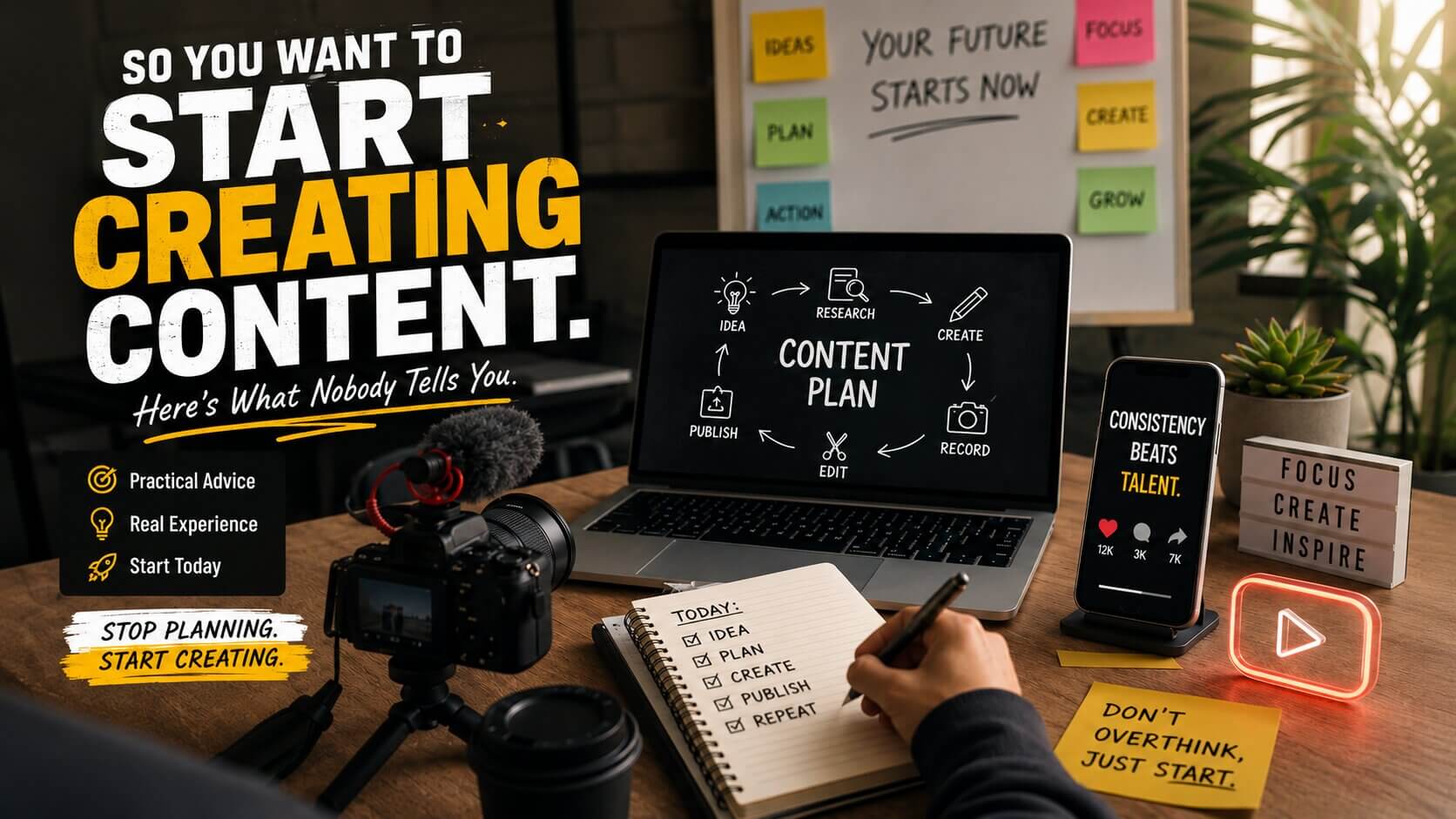
Let me be honest with you. When most people “research” content creation, they end up reading the same recycled list: post consistently, find your niche, engage with your audience, be authentic. Cool. Super helpful. Totally explains why their first three posts got four likes — two of which were from their mom.
Here’s the thing — starting out as a content creator is genuinely hard, and not for the reasons people usually talk about. It’s not the algorithm, it’s not the camera quality, it’s not even the competition. It’s the gap between the content you want to make and the content you’re currently capable of making. That gap is uncomfortable. Most people quit right there.
But if you stick around, it closes. Faster than you think.
This article is for people who are actually starting — not planning to start, not thinking about starting. Actually. Starting. Here’s what you need to know.
Pick One Platform and Get Annoyingly Good at It

One of the biggest mistakes beginners make is trying to be everywhere at once. They post on Instagram, start a YouTube channel, set up a TikTok, and half-heartedly write a blog — all in the same week. Two weeks later, they’ve burned out and none of the accounts has more than 30 followers.
In reality, each platform has its own culture, its own algorithm, and its own content style. What works on LinkedIn will embarrass you on TikTok. What performs brilliantly on YouTube will die on Twitter. You need to learn one before you try to master all of them.
Pick the platform where your target audience already spends time. Then commit to it — really commit — for at least 90 days before even thinking about expanding.
Your First 20 Pieces of Content Will Be Bad. Make Them Anyway.
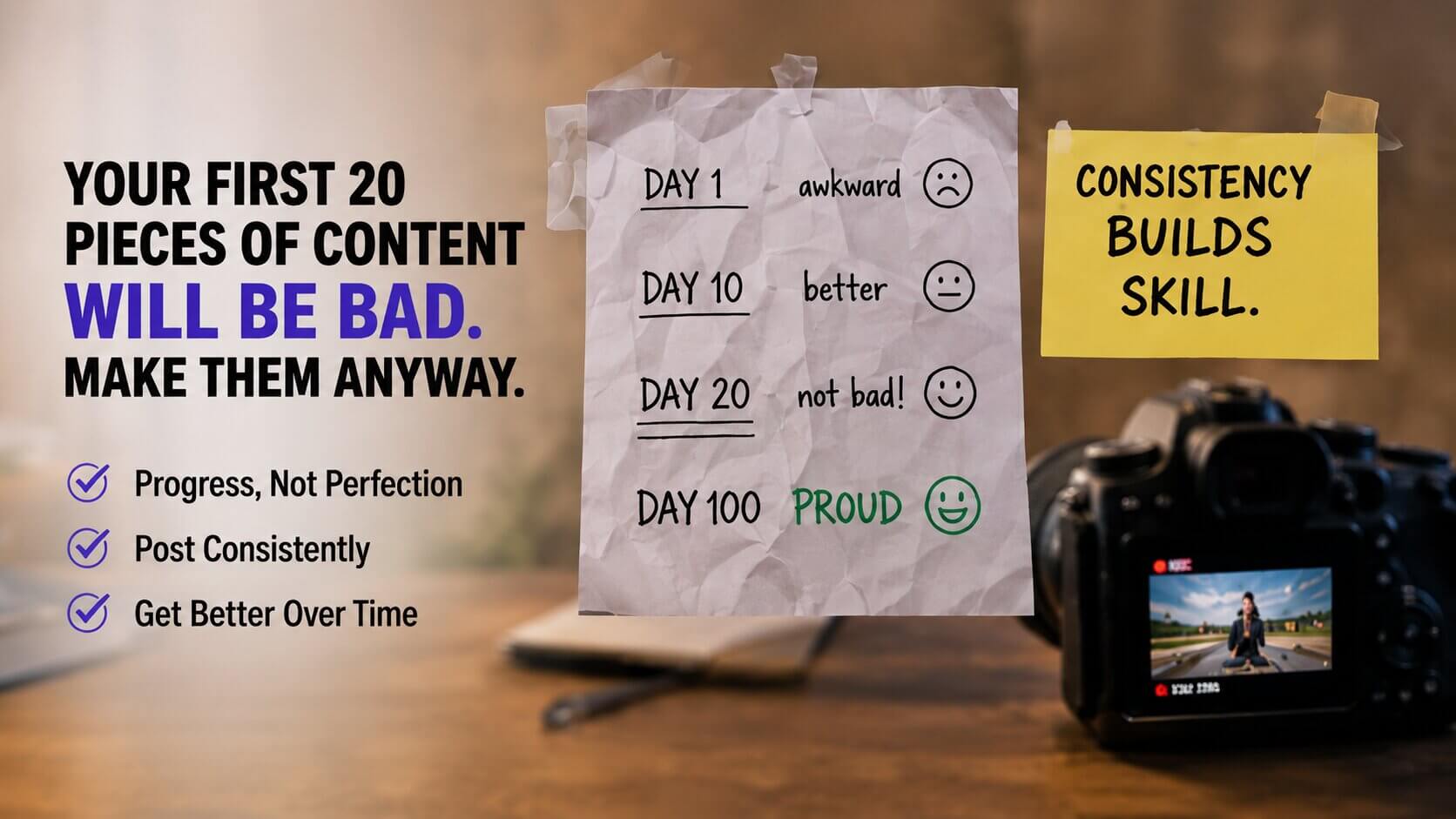
This is the part nobody wants to hear, so I’ll say it plainly: your early content is going to be rough. The lighting will be off. Your hook will be weak. You’ll talk too fast or too slow. You’ll cringe watching it back. That’s completely normal and it means nothing about your future quality.
The creator who posts imperfect content consistently will always outgrow the creator who waits for perfection. Always. Because consistency builds skill, and skill is what eventually makes your content good.
Set yourself a simple rule: for your first month, focus on output, not quality. Give yourself permission to be a beginner. Nobody starts polished — they just start.
The “Niche Down” Advice Is Half Right
You’ve heard it a thousand times: “niche down, niche down, niche down.” And honestly? It’s mostly correct. A channel about “fitness” is vague. A channel about “strength training for people over 40 who have bad knees” is compelling. Specific beats general almost every time.
But here’s where beginners take it too far — they spend weeks or even months trying to perfectly define their niche before they post a single piece of content. That’s backwards. You discover your niche by creating, not by planning.
Hook First. Everything Else Second.
If there’s one technical skill that will do more for your content than anything else in the early days, it’s learning to write a good hook. A hook is the first line of your caption, the first three seconds of your video, the subject line of your email. It’s the thing that makes someone stop scrolling and pay attention.
Most beginners bury the interesting part. They warm up for 30 seconds before getting to the point, or they start a caption with “Hey guys, so today I wanted to talk about…” That’s a skip. That’s someone moving on.
Good hooks do one of a few things:
- Make a bold or counterintuitive statement (“Most fitness advice is making you weaker”)
- Call out the exact person you’re talking to (“If you’ve been posting for 6 months with no results, read this”)
- Promise something specific and valuable (“Here’s the exact template I used to get my first 1,000 subscribers”)
- Ask a question that creates genuine curiosity (“Why do some posts go viral with terrible production quality?”)
Spend as much time on your hook as you spend on the rest of the content combined. That’s not an exaggeration.
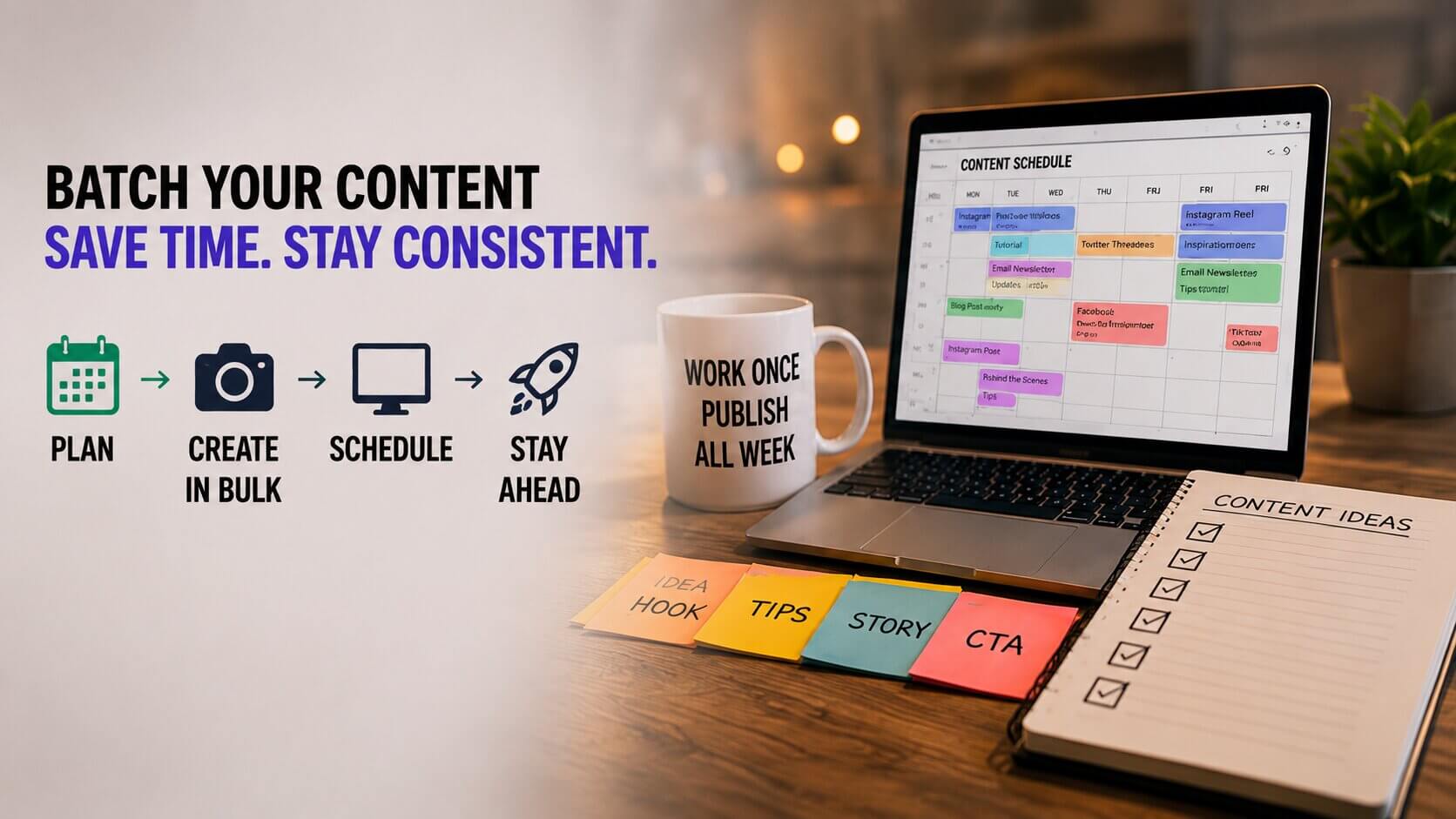
Batch Your Content — Your Future Self Will Thank You
Content creation has a funny way of feeling totally manageable until it doesn’t. You’re posting daily, you’re on a roll, and then one busy week hits — a work deadline, a family thing, a bad cold — and suddenly you’ve missed five days and the momentum is gone.
Once you’ve built a two-week content buffer, that low-level stress of “what am I posting tomorrow” just disappears. That mental space goes back into making better content.
Stop Chasing Trends. Start Noticing Patterns.
Trends are tempting — especially when you see a trending audio or a viral format racking up millions of views. And sometimes jumping on a trend makes sense. But trend-chasing as a primary strategy is exhausting and rarely pays off for beginners because by the time you’ve noticed a trend and made your version, it’s usually dying.
What actually works long-term is pattern recognition. Spend time in your space as an audience member, not just a creator. What questions keep coming up in comment sections? What problems do people complain about repeatedly? What type of content from other creators gets saved and shared?
Those patterns are your content roadmap. They tell you what people actually want, not just what’s trending this week.
Engagement Is a Two-Way Street
Here’s something a lot of beginners genuinely don’t realise: the comment section is not just for receiving feedback — it’s a place to build actual relationships. Reply to comments. Ask follow-up questions. Acknowledge people by name. Show that there’s a real human on the other side of the screen.
My personal opinion? The creators who grow fastest in their early days aren’t the ones with the best content — they’re the ones who make their small audience feel genuinely seen. Ten loyal followers who feel connected to you will do more for your growth than a hundred passive viewers who scroll on and forget your name.
Be generous with your attention, especially early on. It costs you almost nothing and pays back enormously.
Quick Answers: FAQ
How often should I post as a beginner?
Honestly, consistency matters more than frequency. Three times a week that you can actually sustain beats daily posting that burns you out in three weeks. Start with a schedule you know you can keep, then increase it once the habit is solid.
Do I need expensive equipment to start?
No. Your phone is enough. What matters far more is good lighting (a window works great) and clear audio (a $20 clip-on mic is a bigger upgrade than a $500 camera). Gear becomes relevant once your content concept is already working.
How long until I see real growth?
Give it six months of consistent, intentional effort before drawing any conclusions. Most people who “didn’t see results” quit somewhere between month one and month three — right before the compound effect kicks in. Six months of honest effort almost always produces something real.
What if my content isn’t getting any engagement?
Look at your hooks first — that’s where 80% of engagement problems live. After that, check if you’re solving a real problem or just posting things you find interesting. There’s a difference. Ask yourself: “Would someone share this? Would someone save this?” If the answer is no, that tells you what to change.
Should I copy what’s already working in my niche?
Study it, yes. Copy it, no. There’s a big difference between understanding why something works (the format, the structure, the hook style) and just recreating someone else’s video. Take the lesson, not the content. Your perspective is actually the point.
One Last Thing
Content creation isn’t a sprint. It’s not even really a marathon. It’s more like learning a language — slow at first, awkward, humbling, and then one day it just starts to click. You’ll find your rhythm, your voice, your audience. But you have to actually begin.
Stop consuming advice (including this article) and go make something. It doesn’t have to be good. It just has to exist. Your first post is the only one that requires real courage — every single one after it gets a little easier.
You’ve got this. Seriously. Go post something.