

Let me be honest with you right from the start: when I say “no experience,” I don’t mean you’re useless. I mean you haven’t been paid for a skill yet. That’s a very different thing. And that gap — between what you can do and what the market knows you can do — is 100% closeable. I’ve watched people go from “I have no idea where to start” to landing their first paying client in under a month. This article is the map.
So if you’ve been sitting on the fence, convincing yourself that you need a portfolio, a fancy website, or three years of corporate experience before you can freelance — stop. That’s the fear talking. Let’s deal with reality instead.
First, Let’s Talk About What You Actually Have
Here’s the thing most people miss: you probably already have a marketable skill. You’re just not calling it that.
Can you write clearly? That’s copywriting, content writing, or email marketing. Are you weirdly good at organizing things? That’s virtual assistance or project coordination. Do you spend hours editing photos on your phone for fun? That’s social media content creation. Are you someone people come to for Excel help at the office? That’s data entry or spreadsheet consulting.
The freelance economy is enormous — and it rewards specialists, not generalists. You don’t need to be good at everything. You need to be genuinely useful at one thing for a specific type of person.
Take Priya. She worked as a receptionist and spent her evenings making Instagram graphics for her cousin’s bakery — just for fun, no payment. When she finally decided to freelance, she packaged that exact skill: “I create branded Instagram content for small food businesses.” Within three weeks she had two paying clients. She didn’t have a portfolio website. She had a Google Drive folder and a WhatsApp message. That was enough.
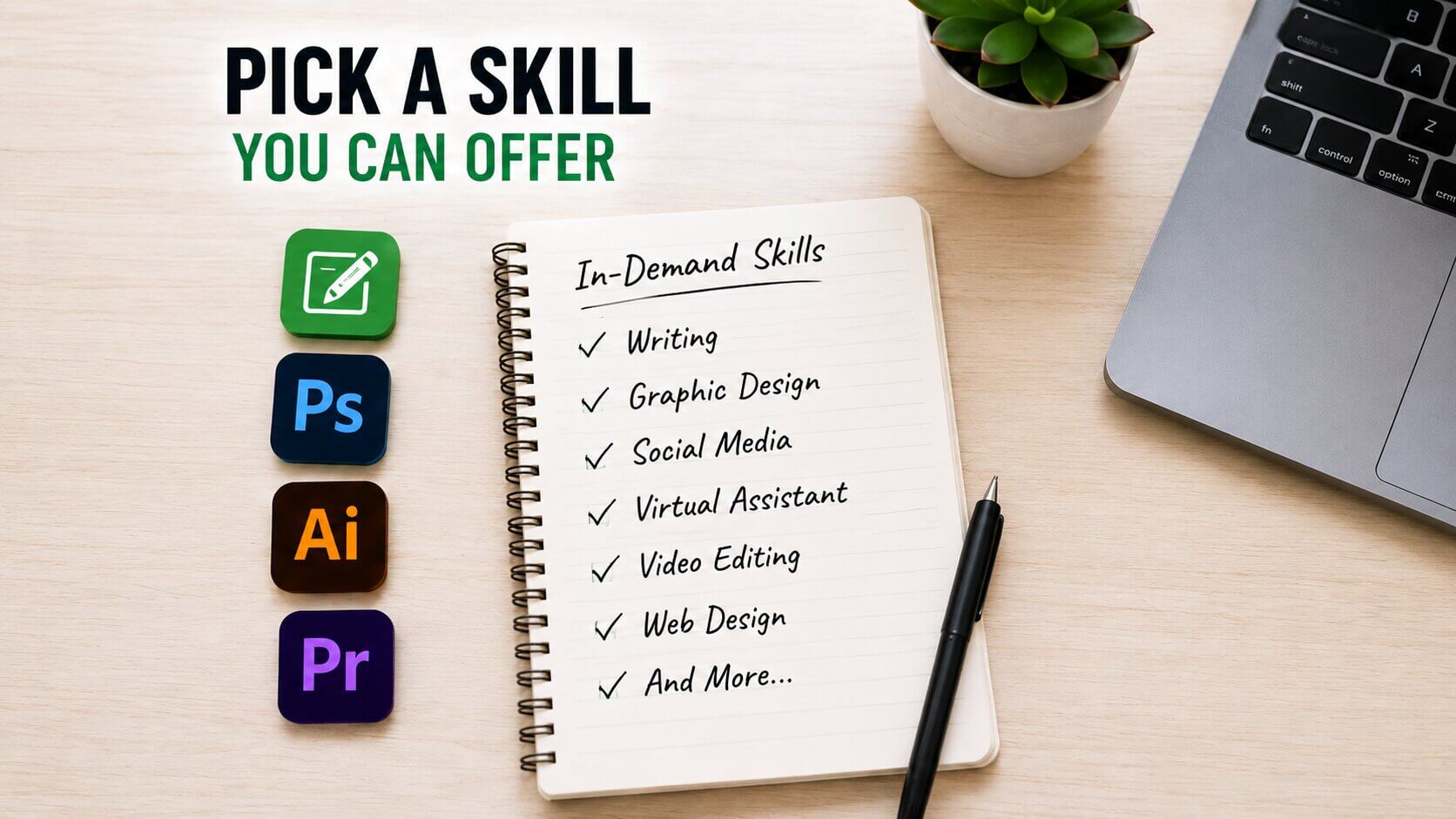
Step 1 — Pick One Skill and Commit to It
This is where most beginners mess up. They try to offer everything — “I can write, design, do social media, help with admin…” — and clients feel nothing. Clarity is what builds trust. You want someone reading about your service to think, “Oh, that’s exactly what I need.”
How to narrow it down:
- What do you get complimented on often, even casually?
- What skill have you used at a job, school project, or hobby?
- What could you spend two hours doing without checking your phone?
- What do people ask you for help with, unprompted?
Pick one. Just one. You can always add more services later — but starting focused is what gets you moving.
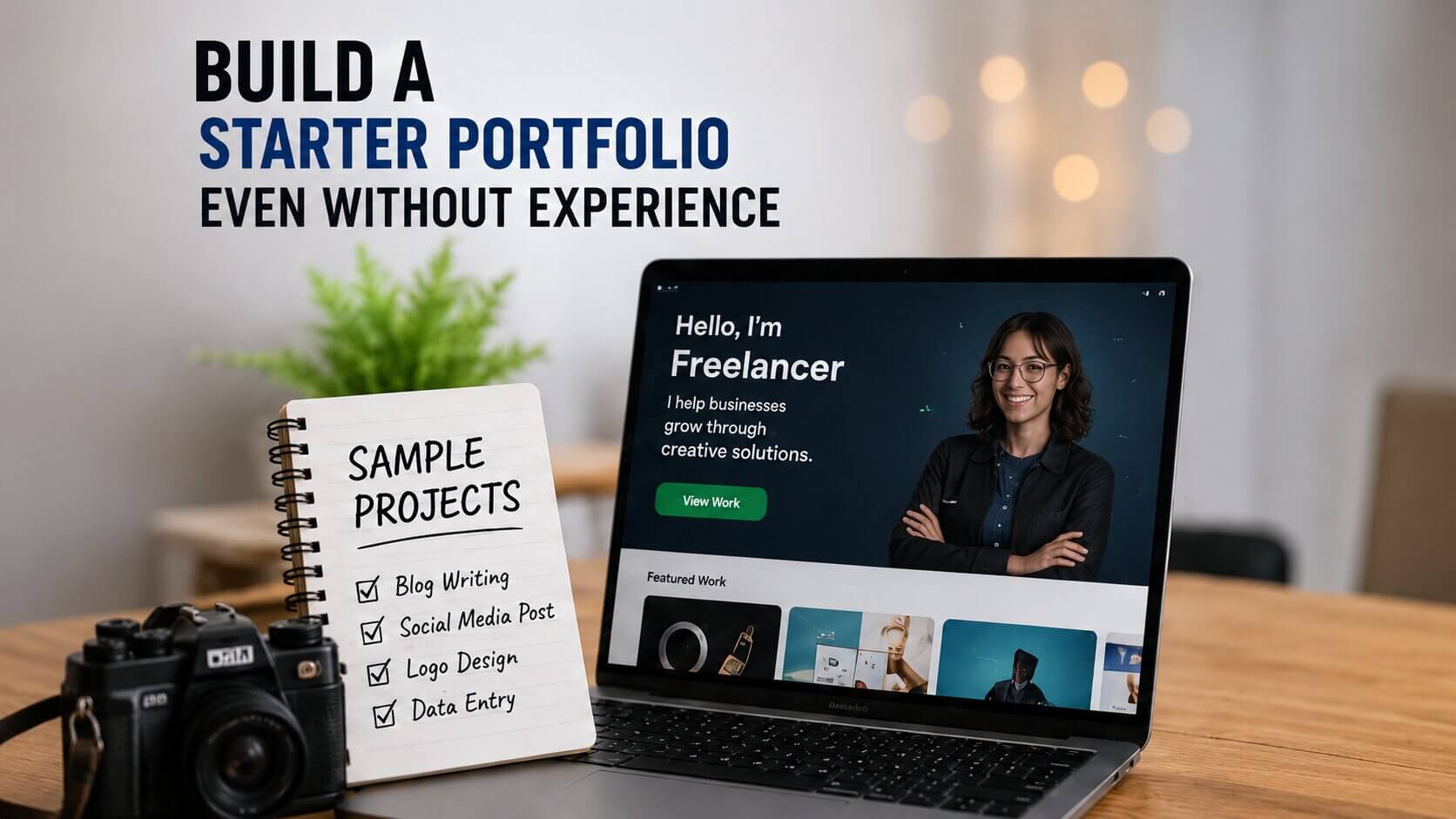
Step 2 — Build a “Starter Portfolio” (Even Without Past Clients)
In reality, nobody expects a brand-new freelancer to have five years of paid work. What they want is proof that you can do the thing. And you can manufacture that proof ethically.
Here’s how:
- Do a sample project: Write a mock blog post for a fake brand. Design a logo for an imaginary coffee shop. Build a sample spreadsheet dashboard. This is real work — it just happens to be self-initiated.
- Help someone for free (once or twice): A local business, a friend’s side hustle, a nonprofit. Get testimonials. Don’t do this forever — just enough to get your first feedback.
- Document your process: Even a short Loom video walking through how you approach a task counts as portfolio material on platforms like LinkedIn.
“Your first portfolio doesn’t prove experience. It proves competence. Those are very different things — and only one of them matters to a client.”
Step 3 — Price Yourself Without Underselling
New freelancers almost always price too low. And look, I get it — it feels safer. You think: “If I charge less, more people will say yes.” But here’s what actually happens: you attract the most difficult, demanding clients who still treat you like you’re overcharging. And you burn out in month two.
A better approach: research the market rate for your skill on Upwork, Fiverr, or Glassdoor freelance reports. Then set your starting rate at around 60–70% of the mid-range. Not the bottom. The lower-middle.
If you’re doing social media content for small businesses, and market rate is $500–$800/month for a retainer, don’t charge $50. Charge $350 and call it your “introductory rate.” It’s honest. It signals value. And it gives you room to raise prices once you have testimonials.
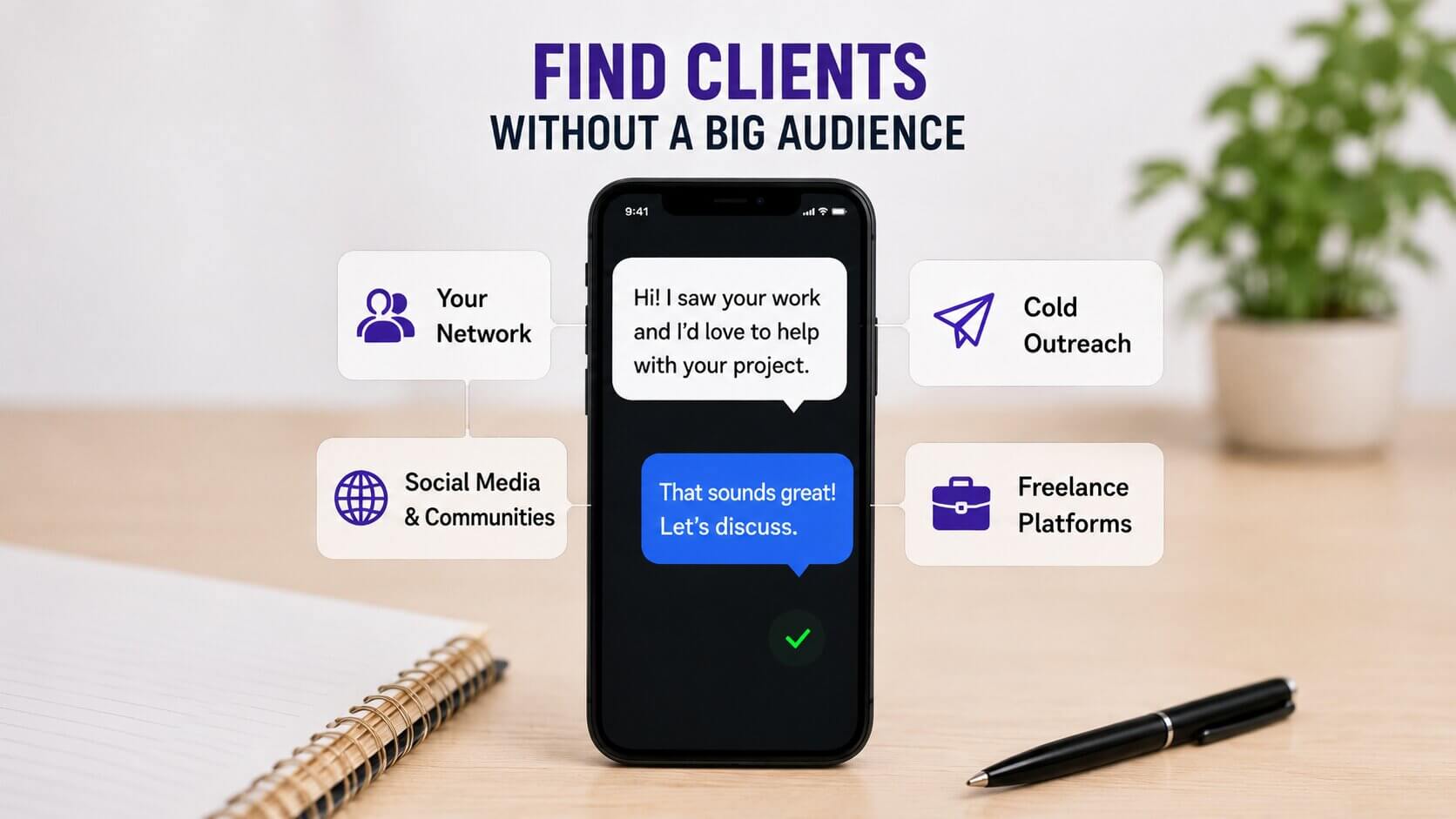
Step 4 — Find Your First Client (Without a Big Audience)
People overcomplicate this. You don’t need thousands of Instagram followers or a viral LinkedIn post to land a client. You need to talk to people.
Marcus wanted to freelance as a video editor but had zero clients. He didn’t post on social media. Instead, he sent 12 direct messages to small YouTube creators in the personal finance space — people with 2,000 to 20,000 subscribers who were clearly overwhelmed. His message was three sentences long: what he did, who he did it for, and a free 60-second edit of one of their existing videos. Three people replied. One hired him. He made $400 that month and $1,200 the month after. Twelve messages.
Here are the best places to find your first clients when you’re starting out:
- Your existing network: Tell people what you’re doing. Most people don’t hire freelancers because they don’t know any — not because they don’t need them.
- Facebook Groups and Reddit communities: Search for groups in your niche. Business owners hang out there asking questions. Answer helpfully, then mention what you offer.
- Cold outreach: Like Marcus did. Targeted, personalized, short. It works.
- Freelance platforms: Upwork, Fiverr, Contra, and Toptal (for more experienced freelancers). Don’t rely on these exclusively, but they’re good for early momentum.
Step 5 — Deliver Well, Then Ask for a Testimonial
Your first few clients are worth more than just money. They’re proof. When you finish a project, do one thing more than expected — send a short summary of what you did and why, or add a small bonus tweak they didn’t ask for. Then, a few days after delivery, send a simple message: “Would you be comfortable leaving a short written testimonial I could use on my website or profile?”
Most people will say yes. And that testimonial is now your most powerful marketing tool. Better than any fancy logo or website.

Common Mistakes to Avoid Early On
- Waiting until your website is “ready” — most clients don’t care about your website at first
- Saying yes to every project — scope creep will destroy you and your motivation fast
- Skipping the contract — even a one-page agreement protects you both
- Working without a clear deadline — always confirm delivery dates upfront
- Disappearing after delivery — follow up, stay visible, build repeat business
FAQ
Do I need to register a business before I start freelancing?
Not right away. In most places you can start as a sole trader or individual without registering anything formally. Once you’re consistently earning, it’s worth talking to an accountant — but don’t let the legal setup stop you from starting.
What if I try and nobody hires me?
That’s almost always a messaging problem, not a talent problem. If you’re not getting responses, revisit how you’re describing what you do and who you’re reaching out to. Get specific. The riches really are in the niches.
How long does it take to land the first client?
It honestly varies. Some people land a client in a week. For others it takes two months. The biggest factor is how actively and specifically you’re reaching out. Passive posting usually takes longer than direct, targeted outreach.
Can I freelance while working a full-time job?
Absolutely — and honestly, that’s the smartest way to start. You can be selective, avoid desperation pricing, and build up savings before going full-time. Just be clear with clients about your availability and response times.
What’s the best platform for beginners?
Fiverr works well for service-based beginners because clients come to you. Upwork requires more proposal writing but often has higher budgets. Contra is newer and has no commission fees, which is a big plus. Try one, get comfortable, then expand.
You Don’t Need Permission to Start
That’s really what all of this comes down to. Nobody is going to tap you on the shoulder and say “okay, now you’re ready.” You have to decide that for yourself. And the bar for starting is genuinely lower than you think.
Pick a skill. Make one sample piece of work. Send ten outreach messages this week. That’s it. You don’t need a perfect website, a business card, or a LinkedIn premium account. You need to start doing the thing and telling people about it.
The freelancers who succeed aren’t always the most talented. They’re the ones who showed up when it felt awkward and uncertain. So go ahead — send that first message. The worst thing that happens is someone ignores it. The best thing? You change how you work for the rest of your life.